It was interesting having my students reflect on their essay writing progress with reference to more embodied experiences.
"As you come in (email me or handwrite) Consider your dorm room: how it's laid out, where you like to be, where stuff is, how you feel, etc. What similarities and differences do you see between your dorm room and where your D3 is right now? (Aim for 3.) How so?"
This blog post is about metacognitive prompts like this. We know that when students reflect on their writing progress and learning, it develops their ability to transfer their learning to new contexts, and develops their intellectual and emotional ability to deal with setbacks and know when to ask for support. In general, Princeton's writing program encourages an extreme amount of metacognitive reflection. Every time students turn in a draft or revision, they must write a one page single-spaced letter talking through their work. In that space, I ask them to reflect on their ideas, successes, failures, hopes, learning outcomes, connections to prior and future writing work, and more. So we've been reflecting a lot.
My current thought is: what if we used, for lack of a better term, rich sources of students' embodied knowledge, goals, and processes to guide some reflection, like one's dorm room? I'm honestly not sure what I'm hoping to find here, but philosophically, what's intriguing to me is my conviction that 1) one of our central tasks as people living in the West is to learn to integrate knowledge from multiple systems (intellectual, but also experiental, bodily, spiritual, emotional, folk, habitual...); and 2) another central task is to make informed interventions in our habits (again, intellectual habits, but also experiential, bodily, spiritual, emotional, folk, habitual...) to gradually become people who can live up to the world. What that means is that I wouldn't be surprised if prompting students to metacognitive reflection via rich sources led to some kind of qualitatively better or more cohesive kind of reflection.
As a preliminary investigation into this, I conducted a small teaching experiment last week. My students were in the finishing stages of drafting their final project, the "D3," and both days we began class with a rich prompt:
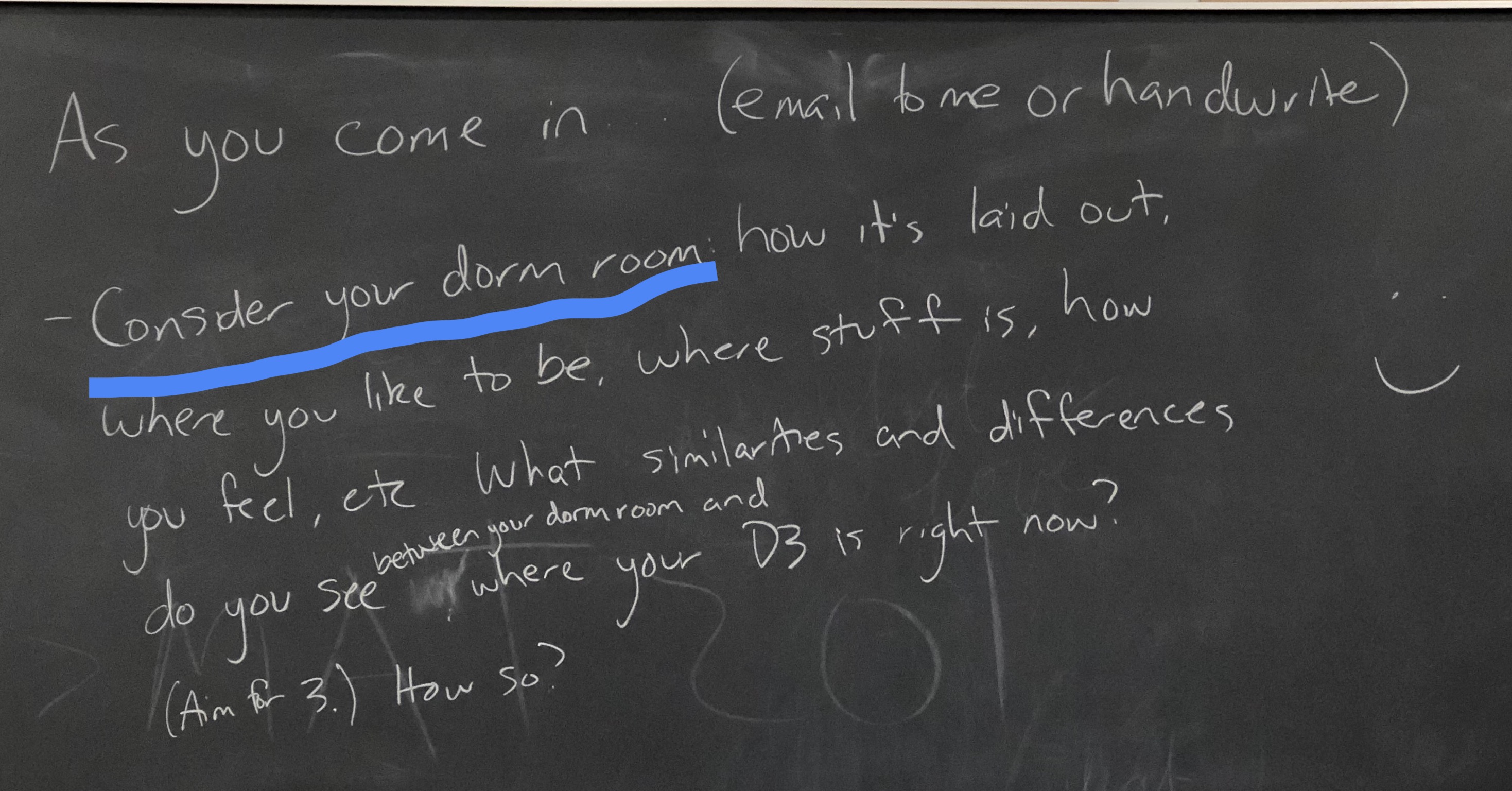
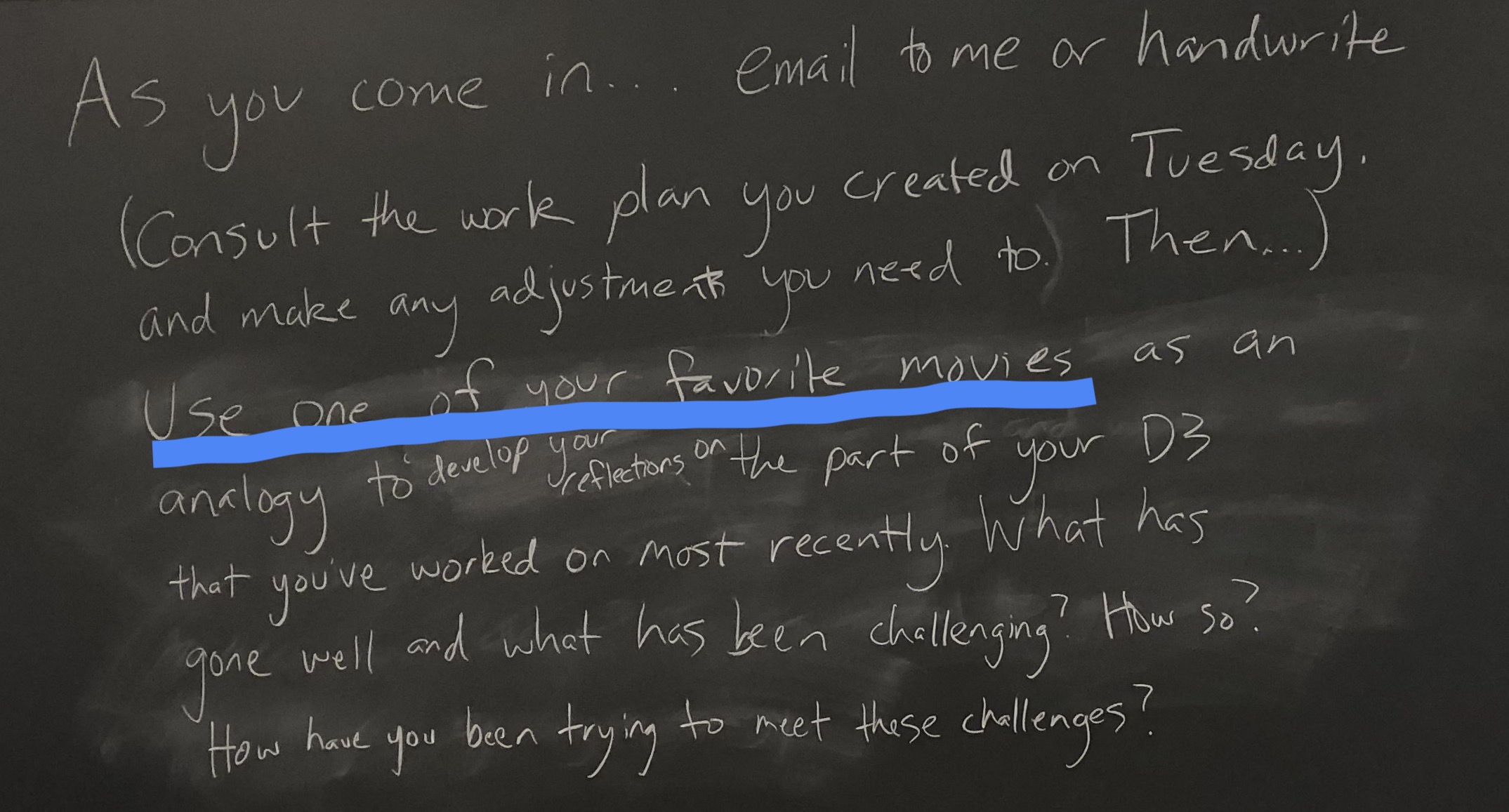
Now you might say, dorm rooms have little to do with an emerging draft, and movies have even less to do with a work plan and literature review. I would agree - there are intentionally few obvious connections, or at least I'm not as an instructor "hunting" for something from my students here. Rather, dorm rooms (and to a lesser extent, favorite movies) are things that we inhabit, things that are spatial and embodied and emotive and full of associated memories. So what might rich metacognitive prompts like these lead to?
Well, it'd be helpful to have something to compare to. Conveniently, I have two sections that meet the same days nearly back-to-back. So each day one section was the control, and the other section received a rich prompt. Then for the other day I swapped them.
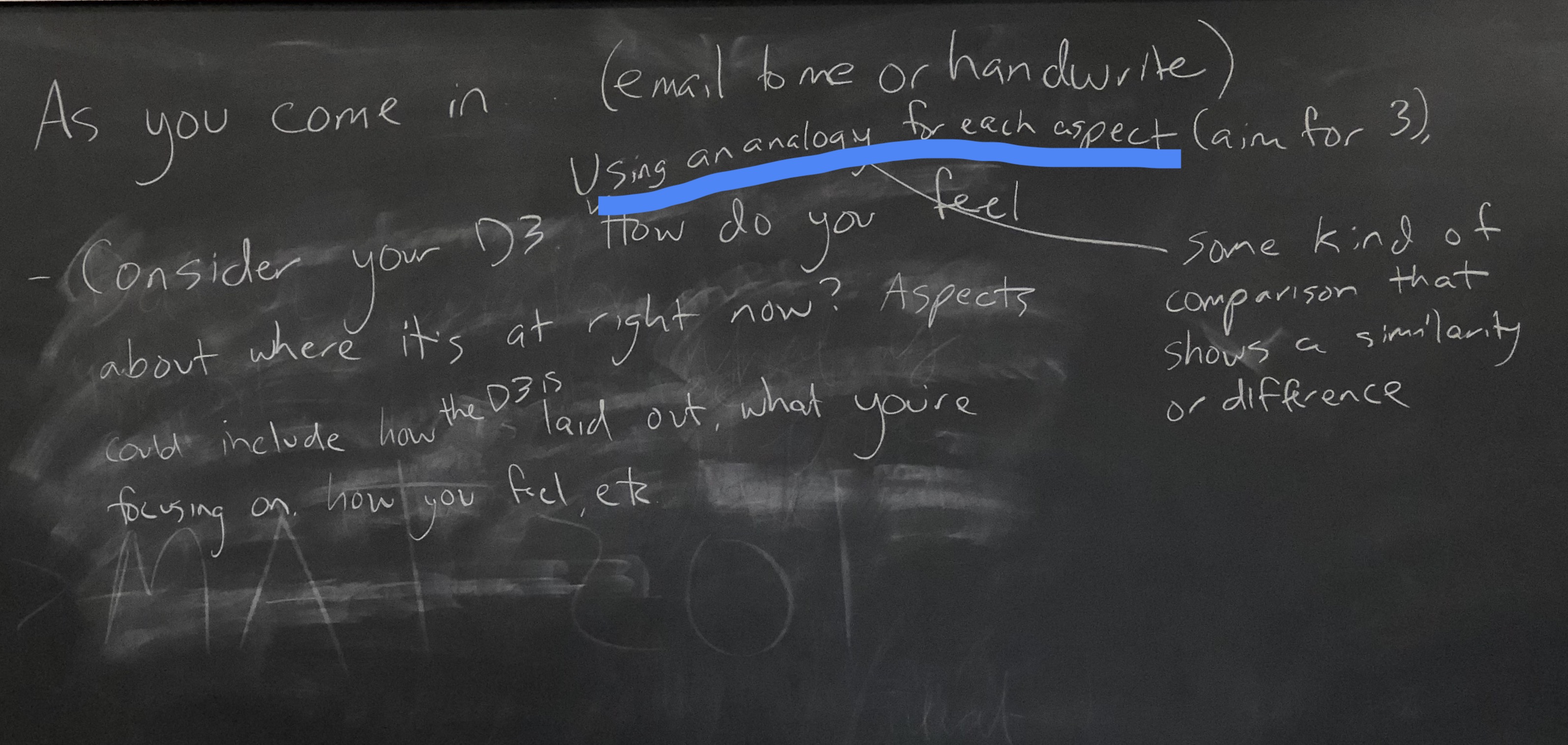
The first control prompt strongly requested analogies to go along with each observation. This "bare" prompt was designed to see what creative connections Princeton students might naturally make. This led to my first finding: unstructured requests for analogies are not fun. One student, for instance, politely announced while we worked on it, "I can’t think of analogies." Two other students kept looking over each other's shoulders, first to get ideas, then to make fun of each other's analogies. Out of 11 students, 5 ultimately just didn't do that part:
...I feel like it will come together quite well by Saturday. I honestly cannot think of an analogy to use here.
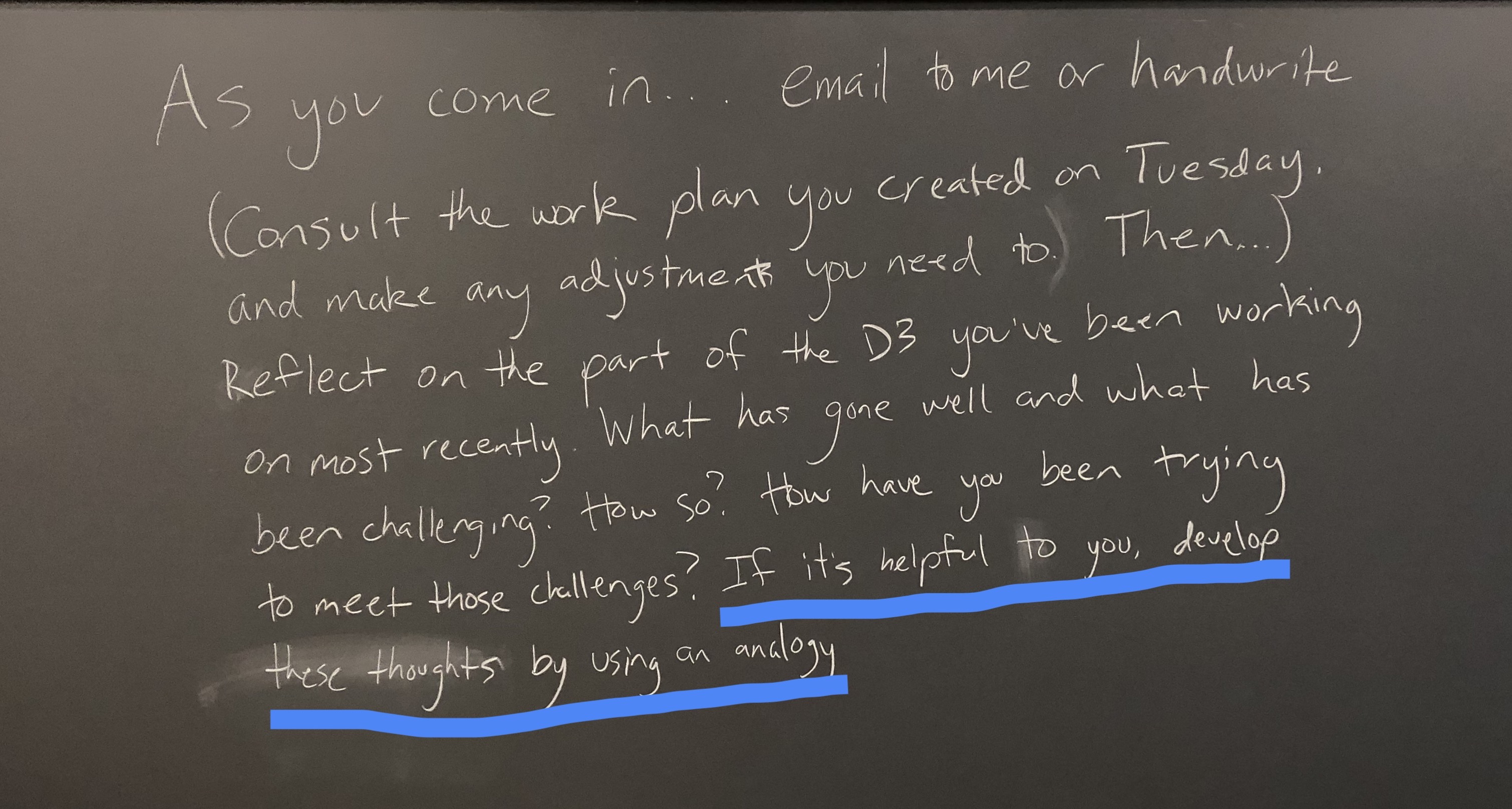
Thus, for the second day, I made the other class' control prompt both lighter but also intended to gesture toward deep intellectual work that analogies might do: "If it’s helpful to you, develop these thoughts by using an analogy." In other words, I tried to give analogies some possibility whether students got a bare, unstructured prompt, or a rich one. Other than that, I tried to use almost the exact same language in the bare prompt as the corresponding rich prompt. And I gave both settings the same amount of time for these opening activities (about 12 minutes of our 80 minute class, plus a few minutes before for the students who came early). Both sections have 12 students, although not all 12 were present for either class either day.
Our first thought might be to go to length. Maybe if there's a structured, rich point of comparison students will write longer?
| Section | Bare prompt | Rich prompt |
|---|---|---|
| Section 1 students (average) | 157 words | 194 words |
| Section 2 students (average) | 159 words | 143 words |
For Section 1, yes, the rich prompt led to longer average reflections than the bare prompt that they did the next day. But Section 2 didn't have much difference. I showed these results to both sections, and Section 2 suspected that this was just because it was the second reflection in the same week. Regardless, look at the length of these reflections! Princeton students are extremely smart, reflective, and thoughtful, especially in 12 minutes. This is a great job.
What about the actual content? Here is the "source" of each analogy used, meaning the-thing-being-compared-somehow-to-the-essay. These are each exact quotes. A few of the sources are repeated (e.g. Thanos) because that person saw multiple connection points with their essay.
| Section | Bare prompt | Rich prompt |
|---|---|---|
| "Source" of Section 1 students' analogies (all) | -child on Christmas; -history of depth first search (DFS); -first encounter with the enemy; -trying to make a dress |
Dorm room: -As much as I have tried convincing my suite mates to keep our Christmas tree in the CENTER of our common room, they have moved it to the very side; -one luggage bag that I never found the time to sort through since spring break; -~20 wii games lying on the shelf under our common room TV; -my room is relatively unorganized, but I know where things are and should go; -I feel relatively comfortable in my room compared with anywhere else on campus; -my room is a quad; and hence my three roommates and I have a shared experience of living together; -at this point in time, I know what is in my dorm room, but everything is scattered about and I have to search to find individual items; -in my dorm room and on my desk especially, there are items that can be tossed in the trash, and doing so would improve my organization as well; -my dorm room is constantly being visited by people, around four-five different people per day. Inevitably, things get moved around as people make themselves comfortable for a few hours; -my room is also laid out in a way to make to help me find relevant stuff as required; -my room layout is constantly changing; -my room is a layout of objects; -the layout of the room is structured just to facilitate my comfort; -my dorm room is small, and my belongings are concentrated in the front right corner by the door, with the exception of my drying rack in the opposite corner; -I sleep on the top bunk, so I have an overhead view of the clutter that is sprawled below; -right now my room is a bit of a mess, as I haven't actually had time to unpack since my trip last week; -[hard deadline for cleaning up] is (probably) not true of my room; -my room has clearly divided work and sleep areas, and I do my best to keep my work contained on my desk while reserving my bed for sleeping; -my dorm room is definitely not the most organized, and things tend to just go where they want; -my dorm room is also rather small; -my dorm room is pretty clean near the doorway/as you first walk in, but it gets progressively more unclean as you move further; -I feel relaxed when I am there; -organization [of rooms]; -I am content; -crowded; -plenty of people have seen my dorm and become comfortable in it; -my shelf in the common room, with all my books and papers, is kind of messy though; -my desk which is pretty full; -I feel comfortable and at home in my dorm room; -my room is not that disheveled, but if you look under my bed, that right there is a proper mess, which stresses me out; -my dorm is very creative, and I like to decorate it as my own; -I'm called the "dorm engineer" by my quad |
| "Source" of Section 2 students' analogies (all) | -all the pieces of the proverbial puzzle; -untangling a headphone cord; -getting over a mountain; -flying from New York to Philadelphia by circumnavigating the globe; -taking a test in pen; -fine-tuning knob on a microscope; -pieces of a puzzle; -unfinished building; -baking cake; -10 mile race; -dipped my toe in the water; -Boston; -well-focused photo with a rather shallow aperture; -last day of classes |
Movies: -the part of You've Got Mail when Meg Ryan is pretty sure that Tom Hanks is the person she's been talking to on the internet but she's not totally sure; -when tried to pair Lee and Carter in the movie Rush Hour; -Memento showed an entire story only showing snippets at a time; -Nicholas Cage's character [in National Treasure] running around the East Coast to find clues for a lost treasure; -the way Cage's character knows that there is a massive treasure to be found even though the process is at times confusing and dubious; -fighting against your own nature and actively seek outside help [Planet Hulk]; -Forrest Gump RUNNING; -almost any movie ever where all the protagonists are doing that preparation montage before the big fight scene; -Thanos putting stones into the gauntlet; -Thanos wiping out half the universe |
A few observations from this list help move us to deeper analysis.
First, the quality of the richly prompted analogies seems much higher than the less structured analogies. They are more elaborated and less stereotypical. Several of the people who did employ a bare-prompted analogy apologized for it, e.g. "Sorry for these rough analogies." In other words, any power that comes from these likely has little to do with analogizing itself, and more to do with the richness of a prompt. That said, the bare prompt did lead to two students choosing something related to their major (the history of depth-first search, a computer science concept; and microscopes, a hard sciences tool). Perhaps a major-specific rich prompt could get this same benfit.
Second, out of the two rich prompts, the dorm room prompt appears more productive than the movie prompt. I suspect that the extra level of choice for students ("What is my favorite movie?") inhibited the movie prompt. My students agreed, noting that dorms are more regular experiences than movies for some of them. This is helpful guidance for how to create good rich prompts in the future. At the same time, a very general look at them shows that dorms and movies tended to lead to different kinds of metaphoric sources (see below). That is, dorm rooms and favorite movies may still both provide insight on rich metacognitive prompts generally.
Finally, the depth of the richly prompted sources of analogies suggests that they really might be doing something for students. Perhaps structured, rich metacognitive prompts enable or facilitate certain kinds of reflection. (This is less prescriptive than something like "demand" or "create" certain kinds of reflection.) Here, the bare prompts are of some interest, but the primary contrast is between the richly prompted reflections and the ways students reflected when they didn't use any analogies.
As I looked through everyone's reflections, I observed four points of interest. (Emphasis added in the quotes below.)
1. Very specific affect: Students who had rich metacognitive prompts frequently used analogies that conveyed very specific emotions. This was most common with the movie prompt:
So far I've felt like Forrest Gump because I've been "RUNNING" from scholarly article to the next, perhaps I need to slow down and analyze each paper more closely. This has been particularly challenging since it has been difficult to decide which papers can be useful, and also how the scholarly papers interact with each other to develop a cohesive motive.
However, much like the way Cage's character knows that there is a massive treasure to be found even though the process is at times confusing and dubious, I am sure that there is a lot to be said about my object once I find a good way to look at it.
Most recently I have been conducting further research for the literature review portion of my paper, which I would liken to the part of You've Got Mail when Meg Ryan is pretty sure that Tom Hanks is the person she's been talking to on the internet but she's not totally sure -- I'm not totally sure if I'm getting the right sources and whether they will not turn out to be great.
But one person even used their dorm room as a way to express a very specific emotion, something like "compromised disappointment that is taken in stride and with humor":
As much as I have tried convincing my suite mates to keep our Christmas tree in the CENTER of our common room, they have moved it to the very side. While I am disapppointed, I am also fortunate in that the final verdict was NOT to simply throw it away. These past couple of weeks have also been disappointing for my D3 progress, but I am fortunate in that yesterday, I suddenly received a stroke of inspiration as I saw a golden path leading me to potential R3 success (more to come on this in person :))
When people made up their own analogy from scratch, they emotions they conveyed were much simpler. The two examples here only hint at frustration:
At the current moment I am sort of untangling a headphone cord like mess of ideas and trying to separate them into distinct dreams [streams?] of thought which I can analyze to throw away or keep.
Overall, I feel like I flew from New York to Philadelphia by circumnavigating the globe.
And in contrast, students who didn't use any analogy tended to express their emotions using modifiers for emotion words, or to imply emotions through describing the process:
Asking people to be a part of this study was simple, and although I had worried about it being too awkward, none of the interactions were abnormally so. I have meetings set up with each of the four participants today for initial testing of the device, and I'm really looking forward to it!
I feel as though the basic outline/idea of using them as a framework for my analysis is a good idea, and it has gone relatively smoothly but I am running into challenges regarding my thesis.
2. Specific conceputal metaphors. Another finding is that different rich metacognitive prompts can encourage different conceptual metaphors. The movie prompt facilitated students situating their writing struggles as part of an expected type or narrative arc:
I have mostly been working on collecting data about how people view ads on Reddit [...] An analogy I have is to almost any movie ever where all the protagonists are doing that preparation montage before the big fight scene
Here, the movie allowed this student to convey not only a current sense of being amped up by the challenge of collecting data (that preparation montage), but a confidence that this effort would lead them to a good outcome in the end (victory in the big fight scene), à la feel-good blockbusters. The Meg Ryan comparison above is similar, in that it grounds that writer's positive hopes for the literature review in the narrative arc of a rom-com.
When students didn't use a richly prompted analogy, they still sometimes expressed confidence in their process, but not based on a "story" of them succeeding:
I am unsure as to what specifically I want to argue. I plan on overcoming this challenge by simply delving more into my analysis - I feel confident that something interesting will reveal itself.
Similarly, the dorm room prompt led to its own set of natural metaphors, mostly about cleanliness and place/movement of objects. I'm less interested in those metaphors theoretically, so I won't focus on them here. Rather, an unexpected conceptual metaphor that came out of the dorm room prompt for multiple students was the impact of sociality as something that could be compared to an essay. In other words, mostly unlike our essay to that point, dorms have people! For some students, the sociality involved in dorm life contrasted with their writing efforts thus far:
My dorm room is constantly being visited by people [...] on the other hand, my D3 has only been seen by my eyes, and has yet to have it or its content seen and edited by others
An important distinction is that my room is a quad; and hence my three roommates and I have a shared experience of living together. Writing my D3 feels more of an individualistic experience.
For other students, the sociality of dorm living allowed them to anticipate peer review and my grading:
My dorm is open, while my D3 is tucked away developing in my password-protected laptop. Therefore, it will be nice to soon have another pair of eyes look at it.
[while playing video games] I can afford embarrassment in front of my friends (I can flatter their ego anyways); the former [D3], I cannot afford such embarrassment in terms of my grade
(In particular, this sense of grading as social - a potential cause of embarrassment - is uncomfortable for me culturally. But it also reveals an alternative to imagining grading as objective.)
Studentse even used dorm-initiated sociality to directly address their audience and socially affirmed creative roles:
While the layout of the room is structured just to facilitate my comfort, the D3 is structured in a way to help not me but my readers.
Although the structure of my dorm presents myriad problems and downsides, I always find a way to fix them. I'm called the "dorm engineer" by my quad. Similarly, I think that I'll be able to pull my project into something wonderful.
In this last case, the role of "author" itself is portrayed as a social process subject to affirmation by others, just like roommate roles are co-constructed.
Outside of the dorm prompt, no student addressed how sociality was impacting their essay's development.
3. Edgy self-disclosure (rapport building). One way to build rapport with someone is to play with the interactional boundaries expected from those roles. I sometimes joke with my students this way, attributing socially unacceptable thoughts to them: "Josh is saying to himself, 'Oh, I'm so glad that we're done with that activity.'" Prompting students to use analogies seemed to give them the freedom to use this style of joking back.
[Analogizing to Thanos in the Avengers story] I am working on rearranging the stones in various configurations and seeing which ones mesh a[n]d which ones do not, and from those ones that mesh, I will be able to pick out the configuration which will yield the most power and wipe out half of all writing seminar professors in the universe.
Obviously, it's not socially acceptable to want to destroy half of the university's writing program (and when I showed both sections a draft of this post, several students seemed to think that this comparison went too far, although I saw some ambiguity in perhaps impressing the writing professors, in the sense of "blowing them away"). I view this comment as a playful connection point that exaggerates the stereotypical student's frustration with a difficult required writing class.
In the dorm room prompt, students had the freedom (and, importantly, not the requirement) to disclose things that a professor typically wouldn't know. This wasn't anything improprietous, just an opening for self-disclosure that goes beyond the space of our classroom and associated work:
I sleep on the top bunk [...]
Perhaps the analogizing itself allowed this to happen. In response to the bare prompt to use analogies, one student used an extended analogy to Christmas Eve:
[...] Each of my passes (enumerated above) correlates with one recitation of my wish list, for I do not want to miss anything, lest I receive the Pokemon game I did not want... or leave in logic holes for Dr. Penman to poke fun at :)
After drawing on the analogy, the student attributes a socially unacceptable attitude toward me, namely that I would aim to "poke fun at" the paper, rather than generously give helpful feedback. But the student also marks this as a joke with the smiley face - this is a rapport-building move.
Students who didn't use analogies also didn't engage in this playful kind of reflection.
4. Very nuanced location of compositional problems. Perhaps most importantly in terms of metacognition, I'm interested in how students are describing their writing challenges. Rich analogies facilitated very nuanced location of these, often going far beyond a simple "mess" dorm room comparison.
My room is relatively unorganized, but I know where things are and should go; likewise, my D3 is just a compilation of my predrafts at this point, but I believe that I have a roadmap for my D3 that will bring it to a full length essay."
I know what is in my dorm room, but everything is scattered about and I have to search to find individual items. There is no sense of overall structure, much like my D3. I know what I'm going to talk about in general, but the specific organization of the paper has yet to be worked out."
My dorm room is pretty clean near the doorway/as you first walk in, but it gets progressively more unclean as you move further. Similarly, my D3 has solid introductory components (literature review, scholarly motive, real-world motive, etc.) but the "meat" of the paper is still rather "unclean" and incoherent in terms of an argument.
My room is not that disheveled, but if you look under my bed, that right there is a proper mess, which stresses me out. I feel the same way about my D3 in that I sense an underlying mess although what I am presenting looks fine."
Clearly, these have nuanced, careful explanations of what is and isn't working. In contrast, when students generated their own analogy from the bare prompt, the analogy wasn't used to develop where/how the challenge was happening:
The layout of my D3 is somewhat akin to Boston: trash. My object of analysis is very focused, as I've spent some time refining it for the IRB, but the background is a bit hazy.
A bad analogy is that my paper is like an unfinished building because it still needs to be constructed and developed before it can be looked at.
That said, students who didn't use an analogy at all still described their writing challenges/progress with detail and precision:
I have found a book which comes very close to arguing exactly what I was intending to do. It feels as though my research gap has disappeared, so I will want to discuss how to frame my argument in a way that adds something new.
The biggest challenge is making one organized argument even though my research and my data is full of contradictions. While I don't simply want to argue "it's complicated", I also want readers to have an idea of the nuance of the material.
In a sense, this isn't surprising. They've been reflecting all semester and have learned to give and receive feedback well. It's also nice to see that, at least preliminarily, rich analogies don't diminish a person's ability to locate challenges and successes. Still, it would be nice to keep an eye on this aspect to see if other rich metacognitive prompts elicit more or less development/specificity.
This little study was conducted out of my curiosity and vague theoretical interest in how we can bring rich, embodied sources of knowledge into the writing classroom, specifically in the role of supporting our writing itself. What I found is pretty strong evidence that rich metacognitive prompts can facilitate reflections with very specific affect, specific conceptual metaphors, and rapport building. If we are to judge a metacognitive reflection on its ability to facilitate greater precision, rich metacognitive prompts seem not to hurt, but may not be compelling. I suspect that this activity is best when students are already doing other metacognitive activities.
I'll likely continue these efforts, and would love to hear if you have any ideas, critiques, or qualifications. My personal takeaways for next time:
- Limit the need for students to make a choice before they begin. It should be specific enough that the prompt is rich, but general enough that everyone has experience with it.
- Explore other domains for rich prompts: a person's major, something about their home town, maybe a special person in their life.
- Make sure I don't design these in a way that becomes like The Giver, sucking away people's memories for the sake of a cool activity.
- Begin thinking about how to encourage students to notice what these prompts draw on. Try to connect to our other reflections on embodiment and writing ("where have you been drafting this essay?" etc.)
- Try to create multimodal embodied classroom experiences that then become the ground for this kind of reflection. (This was actually how I got the idea for this in the first place, and now that I've played it out I can go back to it with more rigor.)
- Pay attention to how the rich prompts compare with regular prompts in terms of what they enable students to reflect on.
- I should probably try this myself with my writing partner.
